Showing posts with label Aboriginal Warfare. Show all posts
Friday, April 15, 2011
Fox Warrior, 1731
While browsing the superb website of the Bibliotheque nationale de France (gallica.bnf.fr) today, I came upon this striking image labeled "Guerrier Renard." It's a watercolor depicting a warrior of the Fox tribe in 1731. The Fox, an Algonquian people, were noted as warlike and appear to have been held in rather low regard by both the French and their Indian neighbors. At that time, they inhabited the region around Green Bay and Saginaw Bay in Wisconsin and Detroit in Michigan. They appear to have had the distinction of being the only tribe against which the French warred. This image represents a people rather outside the bounds of the blog, but it's so impressive, I just had to share it.
Saturday, December 18, 2010
Heath's Armies of the Sixteenth Century (1)
As you can see from the title page, this is volume 2 of Ian Heath's excellent work. This volume deals with the armed forces present in the New World, both European and indigenous. I cannot think of any comparable work and recommend it for anyone interested in the topic. It was published in 1997 and has not been superseded to my knowledge.
The book is divided into five (geographic) sections, not including the Bibliography. This last, incidentally, is quite useful, despite its seeming brevity (It is just four pages long but is set in small type and is quite comprehensive.).
Of course, my interest is with La Florida, and this is covered in the section titled "North America 1497-1608," which provides most of what I'm looking for. Specifically, sub-sections for "Florida" (pp. 123-130) and "Virginia" (pp. 130-134) are useful. "Florida" is a typical treatment. It gives a historical overview of the Spanish and French expeditions (1513-1581) and the Indian cultures of the region. This is followed by a section on warfare, including weapons and forts. Finally, Heath presents his characteristic, detailed line drawings of warriors and soldiers.
Friday, February 12, 2010
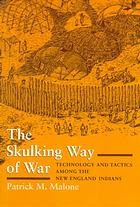
The Skulking Way of War
Malone, Patrick M. The Skulking Way of War: Technology and Tactics among the New England Indians. Lanham, Md.: Madison Books, 1991.
At just 132 pages, of which about 100 are text and the rest notes and related back matter, this is not a thick tome. But, its length belies its erudition and usefulness. In a nutshell, it examines the cultural-military encounter of Indians and whites in colonial New England in the period between the Pequot War (1636-1637) and King Philip’s War (1675-1676). At the beginning of this period, the Indians had few, if any firearms; by the end, most had flintlock muskets and carbines, like the whites. Moreover, they had effectively integrated firearms into their aboriginal, “skulking way of war” and forced the whites in response to adopt the irregular tactics they had scorned in their earlier encounters with the natives.
The author tellingly quotes the observation of one of the white leaders, made after King Philip’s War: “In our first war with the Indians [the Pequot War], God pleased to show us the vanity of our military skill, in managing our arms, after the European mode. Now we are glad to learn the skulking way of war.”
I originally wanted to read this book for insights into native weapons, organization and tactical doctrine, which it provides aplenty. In addition, I found much that was new to me on how the Indians acquired firearms, despite the most stringent prohibitions, and how the whites used native auxiliaries in their military encounters with Indian adversaries.
The book is also copiously illustrated, and the annotated footnotes are most useful, particularly if one wanted to investigate specific subjects in depth.
Subscribe to:
Posts (Atom)